
Spanish-Language ABA Services: Why Bilingual Therapy Matters
Short answer
Only 21.5% of bilingual clients receive ABA intervention in both their languages, despite 21% of the U.S. population speaking a language other than English at home. Bilingual therapy matters because it closes this gap: when services match the languages children actually use, they develop functional communication in the languages their families prioritize, rather than losing skills in their home language.
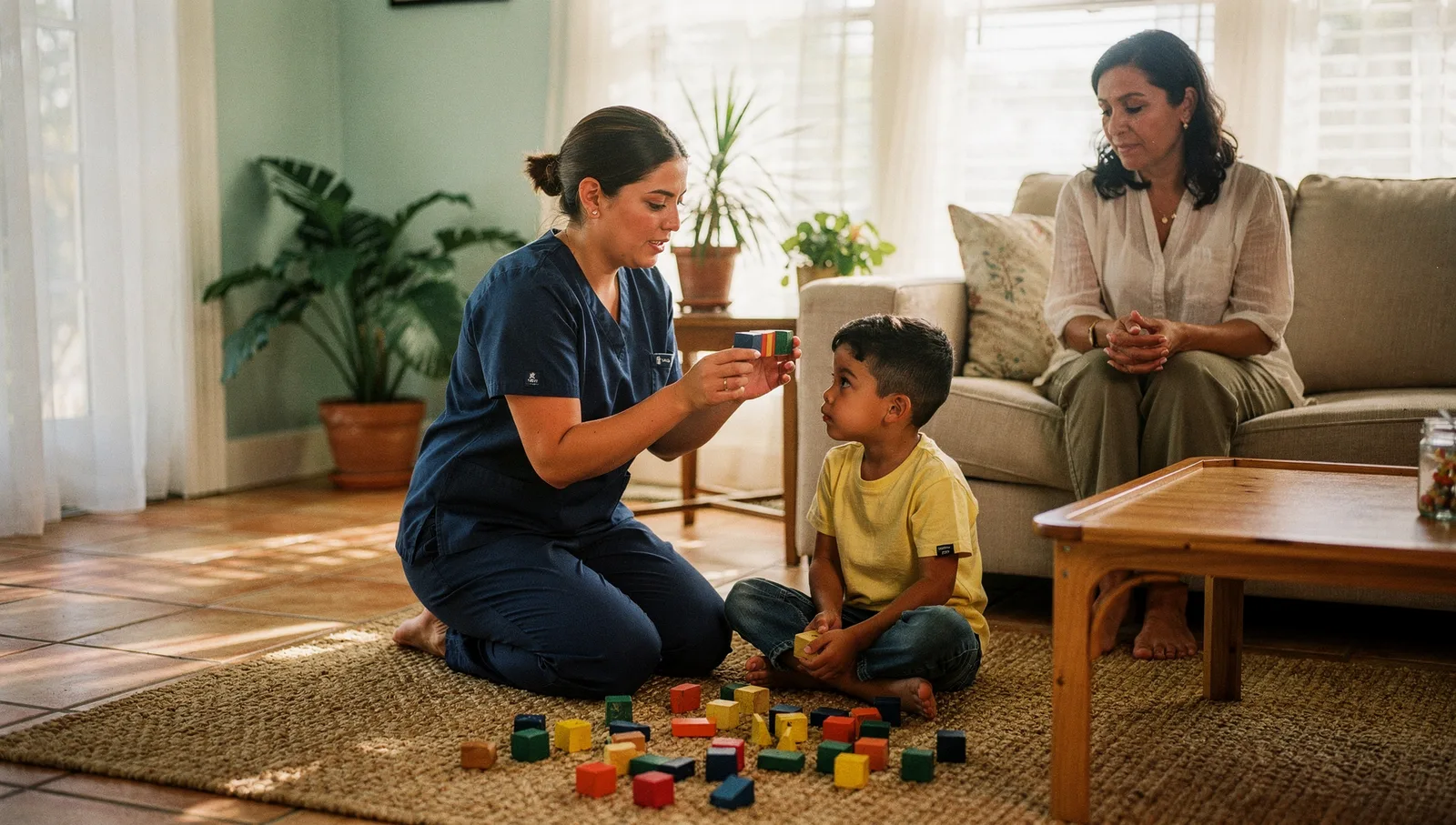
Why Spanish-Language ABA Therapy Matters: The Research and Real Impact#
Your child is diagnosed with autism. The therapist walks in speaking only English. Your family speaks Spanish at home. You nod and agree to the plan, but something feels off, like the therapy is happening in a language that isn't quite your child's world.
That tension is real, and it matters more than most families realize.
The language gap in bilingual ABA services#
Bilingual children in the United States face a stark reality: most autism intervention happens in a single language, usually English. According to survey data on bilingual intervention, only 21.5% of bilingual clients receiving intervention receive it in both of their languages. Meanwhile, about 21% of the U.S. population speaks a language other than English at home, meaning millions of bilingual children are being served in a language that may not be their strongest or the one their family uses most.
The gap between bilingual children's needs and available services exists for practical reasons. Finding bilingual ABA therapists is hard. Training them takes time. Insurance companies don't always reimburse at the same rate for bilingual services. But the gap has a cost: when therapy happens only in English, skills fail to transfer to the Spanish-speaking home where family members cannot reinforce learning, a child may learn to follow instructions in a language they don't use with their parents, siblings, or extended family, so the skills don't generalize at home.
How language choice affects therapy outcomes for Spanish-speaking children#
A child learns fastest and generalizes skills best in their dominant language, the one they use most often and understand best, if your child hears Spanish from birth and English only at school, Spanish is their dominant language with the most vocabulary, strongest emotional connections, and deepest neural pathways for learning.
When ABA therapy happens in that dominant language, functional communication improves faster. A child who learns to request a snack in Spanish can use that skill immediately at home. They can generalize it to new situations because the language is already wired into their daily life. Therapists who work bilingually also catch nuances that monolingual therapists miss: code-switching (moving between languages naturally), cultural communication styles, and family priorities that shape how a child should communicate.
The research is clear on one point: bilingual children do not get confused by two languages. That is a myth that has held back bilingual therapy for decades. Children's brains are built to handle multiple languages from infancy. The confusion happens when therapy ignores one of those languages and the child has to translate learning back to the home language on their own.
Addressing myths about language confusion and autism#
Many families hear this: "If your child has autism, stick to one language. Two languages will confuse them." This advice is wrong, and it can harm your child's development.
Bilingual children with autism learn language the same way bilingual children without autism do. They develop two language systems in parallel. They may mix languages (code-switch) in natural, developmentally appropriate ways. This is not confusion, it is flexibility. A child who can ask for help in Spanish and English has more tools, not fewer.
The real risk is not bilingualism. It is monolingual therapy in a bilingual home. When a child learns to communicate only in English but lives in a Spanish-speaking family, the skills stay in the clinic. At home, the child still struggles to express needs, still relies on behavior to communicate, still cannot participate fully in family life. That is the actual barrier to progress.
Family-Centered Language Goals: Putting Spanish-Speaking Families in Control#
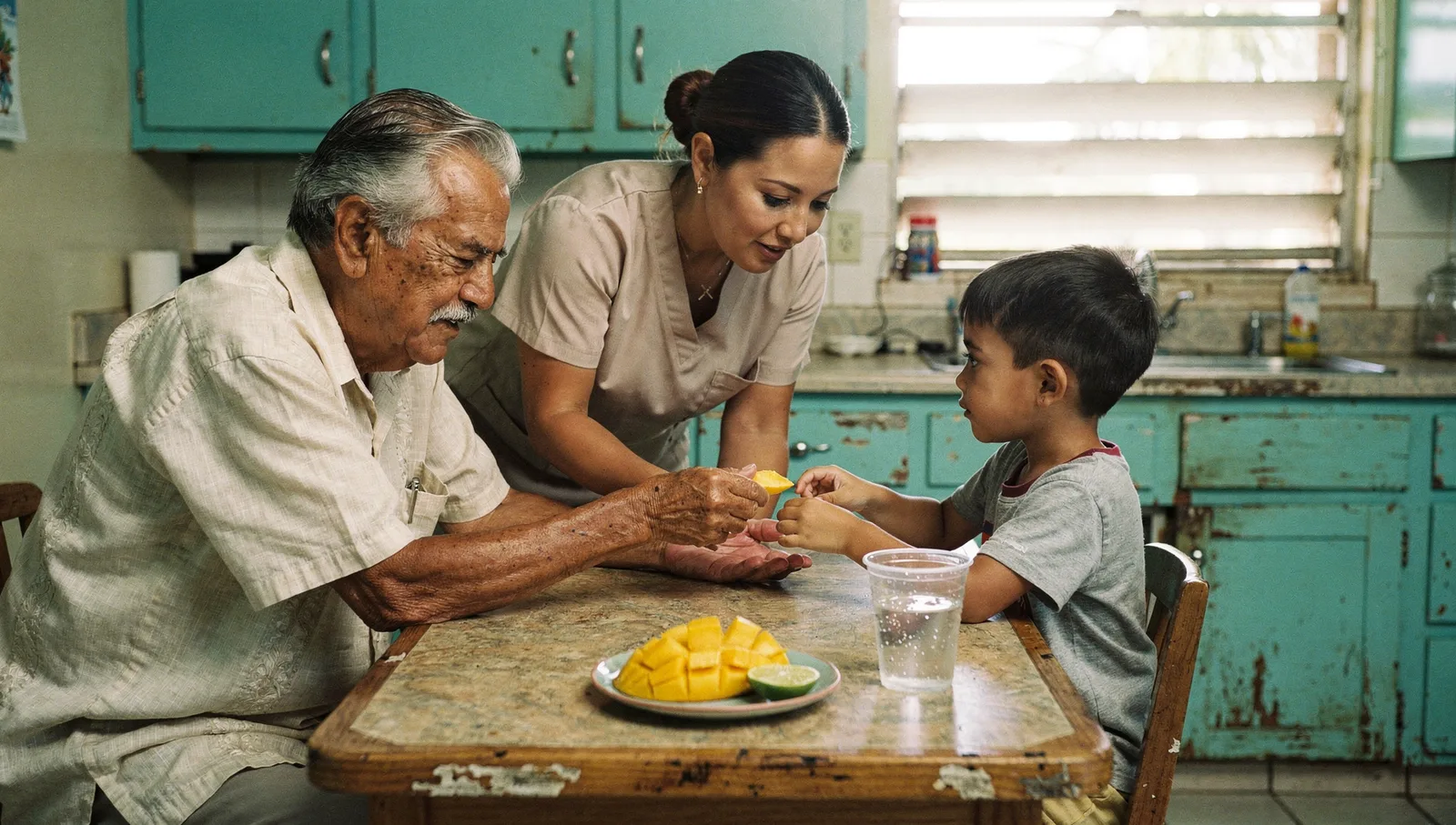
The best ABA therapy for a bilingual child starts with one question: What languages does your family actually use, and which one matters most for your child's life right now?
How to measure progress in both languages simultaneously#
Measuring progress in a bilingual child requires a different approach than tracking a monolingual child. A functional communication assessment in bilingual ABA means testing and tracking vocabulary, requests, and social skills in both Spanish and English. A language dominance profiling at the start of therapy tells you which language is stronger and where the child's gaps are in each language.
Here is what this looks like in practice. A therapist gives your child a picture and asks, "What is this?" in Spanish. The child responds. Then the therapist asks the same question in English. The child may answer in one language, code-switch, or stay silent. That tells the therapist where the child's vocabulary is strongest and where gaps exist. Over weeks of therapy, the therapist tracks progress in both languages on the same skill, not just "the child learned to label objects," but "the child labels a range of objects in Spanish and fewer in English, with some objects labeled in both languages."
Dual-language tracking prevents a hidden problem: a child who appears to be making progress in English-only therapy but is actually falling behind in Spanish vocabulary at home. When you measure both languages, you see the real picture.
Letting families choose which language to prioritize in therapy#
Not every family wants equal progress in both languages. Some families are planning to move to a Spanish-speaking country. Others live in an English-dominant community and want their child to succeed in school first. Some families want therapy in Spanish because that is where the child is strongest, and English will come later.
A family-centered approach means you decide. Before therapy starts, a bilingual ABA clinician should ask you directly: Which language is most important for your child's daily life right now? Which language do you want your child to use with you? Are there specific situations where your child needs to communicate in one language more than the other?
Your answers shape the therapy plan. If Spanish is the priority, the therapist focuses there first, building a strong foundation. English skills follow naturally as the child's overall communication improves. If your family wants balanced bilingualism, the therapist divides focus. If you want English-dominant therapy because your child attends English-speaking school, that is a valid choice, but the therapist still measures progress in Spanish so you know what is happening at home.
Bilingual therapy with a family-chosen priority is not the same as monolingual therapy. It is bilingual therapy with a family-chosen priority. The difference is that the therapist knows about both languages, can code-switch when needed, and can help you reinforce skills in Spanish even if English is the main focus.
When and how to switch languages during therapy sessions#
Code-switching in therapy is not a mistake. It is a tool.
Here is when a therapist might code-switch:
- To clarify a difficult instruction. If a child does not understand a request in English, the therapist repeats it in Spanish. This is not giving up; it is ensuring the child understands what is being asked so they can learn the skill.
- To reinforce a new skill. A therapist might teach a skill in Spanish (the child's dominant language) and then practice it in English, so the child learns the skill in both languages.
- To match the child's natural communication. If a child code-switches naturally, a bilingual therapist code-switches back, keeping the interaction natural and the child engaged.
- To build confidence before moving to a weaker language. A child who is shy or frustrated may respond better if the therapist starts in the stronger language, builds success, and then introduces the weaker language.
The key is intentionality. A therapist who code-switches randomly or without a plan is not doing bilingual therapy, they are just speaking two languages. A bilingual ABA therapist has a reason for every language choice and can explain it to you.
Designing individualized language goals across both Spanish and English#
An individualized language goal in bilingual ABA is not "the child will speak more." It is specific, measurable, and tied to your family's real life.
Here are examples of well-designed bilingual language goals:
- Functional request goal: The child will request preferred items in Spanish with high accuracy across multiple different items and different people (parent, therapist, sibling).
- Dual-language labeling goal: The child will label household objects in Spanish and in English, with some objects labeled in both languages, demonstrating understanding across both languages.
- Code-switching goal: The child will use code-switching appropriately in conversations with bilingual family members, switching languages to match the listener's preference or the topic.
- Functional communication in context: The child will ask for help in Spanish at home and in English at school, using the appropriate language for each setting.
Each goal has a language hierarchy built in. The therapist knows which language to teach first, when to introduce the second language, and how to measure success in both. This is different from a monolingual goal because it acknowledges that your child lives in two languages and needs to function in both.
ABA therapy's discipline of measuring behavior and tracking progress is exactly what makes bilingual goal-setting work. You can see, week by week, whether your child is making progress in Spanish, in English, or in both.
Building Bilingual ABA Services: Clinician Qualifications, Cultural Responsiveness, and Parent Collaboration#
Not every ABA therapist who speaks Spanish is a bilingual ABA therapist. The difference matters.
What bilingual ABA staff qualifications really mean#
A bilingual ABA therapist requires both deep ABA methodology knowledge and genuine bilingual fluency, speaking Spanish alone is insufficient; the therapist must conduct functional communication assessments in both languages, design goals that respect language dominance, and recognize when a child's behavior stems from a language barrier rather than a skill deficit.
In practice, this means the therapist has formal training in bilingual development, understands how autism presents differently across languages, and can explain ABA concepts to families in their native language, not just translate English materials word-for-word. A therapist who is bilingual by heritage but has no formal training in bilingual language development may miss important patterns. A therapist who is fluent in ABA but speaks Spanish as a second language may not catch the cultural nuances that shape how a family communicates.
The strongest bilingual ABA teams include therapists who are native or near-native speakers of Spanish, trained in ABA methodology, and supervised by a bilingual BCBA (Board Certified Behavior Analyst) who can review their work and ensure quality. This supervision is critical because bilingual therapy is more complex than monolingual therapy, and mistakes are easier to miss.
Cultural responsiveness in therapy delivery and family partnerships#
Cultural responsiveness in ABA means more than translating materials into Spanish. It means understanding how your family's culture shapes communication, learning, and what you value in your child's development.
In many Hispanic families, communication is more indirect than in mainstream American culture. A child may not make direct eye contact as a sign of respect, not disrespect. Family decisions are made collectively, not by one parent alone. Extended family plays a central role in child-rearing. A culturally responsive ABA therapist knows this and does not try to change it. Instead, the therapist works within your family's style.
For example, a monolingual ABA therapist might set a goal for a child to make eye contact during conversation. A culturally responsive bilingual therapist asks first: Is eye contact important in your family's culture? If not, we can focus on other ways your child shows attention and respect. This is not lowering standards; it is setting goals that actually matter to your family and that your child can generalize to real life.
Cultural asset-based practice is the term for this approach. Instead of focusing only on what your child cannot do, a bilingual therapist looks at the strengths your family brings: the languages you speak, the extended family network, the values you hold, the ways you already support your child. The therapy plan builds on those assets.
Parent training that works across two languages#
Parent training in ABA is where the real change happens. A therapist sees your child for a few hours per week. You are with your child all the time. If you do not know how to use ABA strategies, the progress stops when the therapist leaves.
Bilingual parent training means the therapist teaches you strategies in the language you speak at home, using examples from your daily life. Instead of a generic handout about "reinforcement," the therapist shows you how to reinforce your child's Spanish requests during dinner, during bath time, during the car ride to school. The strategies are the same; the language and context are yours.
A good bilingual ABA program also trains you to recognize and reinforce code-switching, not punish it. Many parents worry that code-switching is a sign their child is confused. A bilingual therapist explains that code-switching is normal and smart, and shows you how to respond in ways that support your child's bilingual development.
Finding and Affording Spanish-Language ABA Services in South Florida#
If you are searching for bilingual ABA therapy in South Florida, you are likely facing two barriers: availability and cost. Both are real. Here is what you need to know.
Bilingual ABA therapy availability in Miami-Dade, Homestead, Kendall, Hialeah, Marathon, and Key West#
Spanish-language ABA services in South Florida are concentrated in Miami-Dade County, where the Hispanic population is over 30 percent and demand is highest. In Homestead, Kendall, and Hialeah, bilingual ABA providers exist but waitlists are long. In Marathon and Key West, options are far more limited, and many families travel to Miami for services.
Permuy Diversity Intervention, licensed (license #MH-15621) and insured, serves bilingual ABA therapy and counseling across Miami-Dade County, Homestead, Kendall, Hialeah, Marathon, Key West, and Monroe County.
When you are looking for a bilingual ABA provider, ask these questions:
- Is the therapist a native or near-native Spanish speaker?
- Does the provider conduct functional communication assessments in both languages?
- Can the provider explain how they measure progress in Spanish and English?
- Does the provider have a bilingual BCBA supervising the case?
- Can the provider work with your family's language priorities, not just offer monolingual therapy in Spanish?
If a provider says they offer "Spanish-language ABA" but the therapist is not fluent in Spanish, or if they cannot explain how they measure bilingual progress, keep looking.
Navigating insurance and funding barriers for Spanish-language ABA in Florida#
Here is the hard truth: insurance companies in Florida often reimburse ABA therapy at the same rate regardless of whether it is monolingual or bilingual. This sounds fair until you realize that bilingual therapy takes more time to plan, requires more skilled clinicians, and costs the provider more to deliver. Many bilingual providers absorb the extra cost or limit their bilingual caseload because the reimbursement does not cover it.
Medicaid in Florida does cover ABA therapy for children with autism, and it covers therapy in Spanish. But Medicaid rates are lower than private insurance, and the approval process can be slow. Many families wait months for authorization, and some providers do not accept Medicaid because the reimbursement is too low.
Here is what you can do:
- Check your insurance plan's ABA coverage. Call your insurance company and ask: Does your plan cover ABA therapy? Is there a limit on hours per year? Do you need a referral from your child's doctor? Does the plan cover therapy in languages other than English?
- Ask about Medicaid. If your family qualifies for Medicaid; your child is eligible for ABA therapy. Contact your local Medicaid office or your child's pediatrician for a referral to an ABA provider.
- Ask providers directly about bilingual rates. Some providers charge the same rate for bilingual and monolingual therapy. Others charge more because the clinician is more skilled. Ask what you will pay and what your insurance will cover.
- Look for providers who accept your insurance. A provider who is in-network with your insurance will bill your plan directly, and you will pay only your copay or deductible. Out-of-network providers may require you to pay upfront and seek reimbursement yourself.
The cost of ABA therapy in Florida varies widely depending on the provider, the intensity of services, and your insurance coverage. With insurance, you may pay only a copay per session. With Medicaid, you typically pay nothing, but waitlists are longer.
What to expect: ABA therapy costs and service models in Florida#
ABA therapy in Florida is typically delivered in one of three models:
In-home therapy. A therapist comes to your home for sessions, usually for a few hours per week, depending on your child's needs and your insurance approval. In-home therapy is more expensive than clinic-based therapy because of travel time, but it allows the therapist to work in your child's natural environment and train you directly.
Clinic-based therapy. Your child attends sessions at a clinic, usually for a couple of hours per week. Clinic-based therapy is less expensive than in-home therapy, but it requires you to travel, and the skills may not generalize as easily to home.
Hybrid model. Some providers offer a mix of in-home and clinic sessions, or group sessions at a clinic combined with individual in-home sessions. This model tries to balance cost and effectiveness.
The number of hours your child receives per week depends on your insurance approval and your family's needs. Some children receive a few hours per week; others receive intensive services. Intensive services are more expensive but may lead to faster progress.
When you are evaluating cost, ask the provider:
- What is the cost per hour of therapy?
- Does the cost include supervision by a BCBA?
- Are there travel fees for in-home therapy?
- What does your insurance cover, and what will you pay out of pocket?
- How many hours per week does your child need, and for how long?
A bilingual provider may cost slightly more than a monolingual provider, but the investment pays off: your child learns faster. Your family can reinforce skills at home, and the therapy actually works in your child's real life.
Putting It All Together: Your Next Step#
You now understand why bilingual ABA therapy matters, how it works, and what to look for. The last step is action.
Start here:
Identify your family's language priorities. Which language does your child use most? Which language do you want your child to use with you? Write this down, it will guide every conversation with a provider.
Find a bilingual ABA provider in your area. Use the questions above to evaluate whether they are truly bilingual and whether they measure progress in both languages. Ask for references from other bilingual families they have served.
Ask about insurance and cost. Call your insurance company and ask about ABA coverage. If you qualify for Medicaid, start the application process now, waitlists are long. Get a quote from the provider and understand what you will pay.
Schedule a consultation. A good bilingual ABA provider will offer a free initial consultation. Use it to ask questions, share your family's language priorities, and see whether the provider is a good fit.
Start therapy with a clear plan. Before the first session, make sure you and the provider agree on language goals; how progress will be measured in both languages, and how you will reinforce skills at home in Spanish.
Bilingual ABA therapy is not a luxury. It is the most direct path to helping your bilingual child communicate, learn, and thrive in both languages. When you choose a provider who understands bilingualism, respects your family's culture, and measures progress in both Spanish and English, you are not just getting therapy, you are getting a partner who sees your child's bilingualism as a strength, not a problem.
Talk to a bilingual ABA team who gets it: Medicaid-approved ABA therapy and counseling for your child in English or Spanish, across the Florida Keys and Miami-Dade. The next step is a conversation.
| Metric | Percentage | Source |
|---|---|---|
| Bilingual clients receiving intervention in both languages | 21.5% | PMC |
| U.S. population speaking a language other than English | 21% | Scholarsarchive |
| Service gap (population vs. bilingual intervention coverage) | Estimated significant gap | Derived from comparison |
| Factor | English-Only Therapy | Bilingual Therapy (Including Spanish) |
|---|---|---|
| Skill generalization to home environment | Limited, skills may not transfer when family speaks Spanish | Stronger, child uses skills immediately in daily Spanish-speaking contexts |
| Language dominance alignment | Mismatched if child's dominant language is Spanish | Matched to child's strongest language and family communication |
| Detection of communication nuances | Monolingual therapist may miss code-switching and cultural styles | Bilingual therapist catches natural code-switching and family priorities |
| Progress tracking accuracy | May show English progress while Spanish vocabulary lags undetected | Dual-language tracking reveals true progress in both languages |
| Location | Hispanic Population | Relevance to Bilingual Services |
|---|---|---|
| Aurora, Colorado | Over 30% | Significant Spanish-speaking community requiring bilingual ABA access |
| U.S. General Population | 21% speak non-English language at home | Nationwide need for bilingual intervention across multiple linguistic communities |
ABA Therapy Out-of-Pocket Cost Estimator
Estimates annual out-of-pocket costs and insurance coverage for ABA therapy based on prescribed weekly hours, standard hourly billing rate, and health insurance cost-sharing parameters (annual deductible, coinsurance percentage, and out-of-pocket maximum).
Total Billed Therapy Cost (Annual):
Estimated Annual Out-of-Pocket Cost:
Estimated Insurance Coverage:
Effective Out-of-Pocket Cost per Hour:
Frequently Asked Questions
What should I look for when choosing bilingual ABA therapy services in my area?
Seek providers who conduct language dominance profiling before therapy begins and track progress in both your family's languages simultaneously. Ask whether they measure vocabulary, requests, and social skills across both Spanish and English, not just one language. Verify they involve families in setting priorities, which language matters most for your child's daily life right now, rather than defaulting to English-only intervention.
Will my Spanish-speaking child with autism become confused if they receive therapy in both Spanish and English?
No. Bilingual children with autism develop language the same way as bilingual children without autism, through two parallel language systems. Code-switching (moving between languages naturally) is developmentally appropriate flexibility, not confusion. The real risk is monolingual therapy in a bilingual home, where skills stay in the clinic and don't transfer to family life.
How can I measure my child's real progress in bilingual ABA therapy?
Insist on dual-language progress tracking from day one. Instead of only seeing that your child 'learned to label objects,' ask for specific data: which objects they label in Spanish, which in English, and which bilingually. This prevents the hidden problem where a child appears to progress in English-only sessions while Spanish vocabulary falls behind at home.
Can I choose to focus therapy on just one language, even though my family is bilingual?
Yes, a family-centered bilingual approach puts you in control. Before therapy starts, discuss directly with your clinician which language matters most for your child's daily life and which language you want your child to use with you. Some families prioritize English for school success initially; others prioritize Spanish because it's the child's strongest language.
Why do most ABA therapists I encounter speak only English?
Finding and training bilingual ABA therapists is difficult, and systemic barriers exist. Insurance companies don't always reimburse bilingual services at the same rate as English-only therapy, and the investment in training bilingual providers hasn't matched the population need. This supply gap means many families must accept English-only services, even when bilingual therapy would produce better outcomes.
What is the difference between my child code-switching and being confused about language?
Code-switching, using both Spanish and English in natural, developmentally appropriate ways, is a sign of linguistic flexibility and strength, not confusion. A child who asks for help in Spanish one moment and English the next has more communication tools available. Confusion would mean the child cannot access either language effectively; bilingual children typically show strength in both.
Disclaimer
The information provided by Permuy Diversity Intervention is for general educational purposes only and is not a substitute for professional medical advice, diagnosis, or treatment. ABA therapy and mental-health services are individualized; always consult Dr. Luis D. Permuy, LMHC-QS, or a qualified clinician about your child's specific needs. Insurance coverage, eligibility, and Florida Medicaid rules change - verify current details with your plan and the Florida Agency for Health Care Administration.
Sources
- pmc.ncbi.nlm.nih.gov (via Perplexity Sonar) - PMC (2026-08-29)
- scholarsarchive.byu.edu (via Perplexity Sonar) - Scholarsarchive (2026-08-29)
- Multilingual Service Delivery in Audiology and Speech-Language Pathology - American Speech-Language-Hearing Association (ASHA) (2026-09-14)