
ABA Therapy for Nonverbal Children with Autism: Strategies and Success
Short answer
ABA therapy for nonverbal children with autism uses Discrete Trial Training, Functional Communication Training, and Natural Environment Training to build communication and adaptive behavior. Research shows strong gains in expressive language when delivered intensively (25-40 hours weekly for two or more years). Outcomes vary: 46% remain in services at 24 months, while most show meaningful progress. Success depends on early assessment, BCBA oversight, caregiver coaching, and consistent progress monitoring, not therapy hours alone.
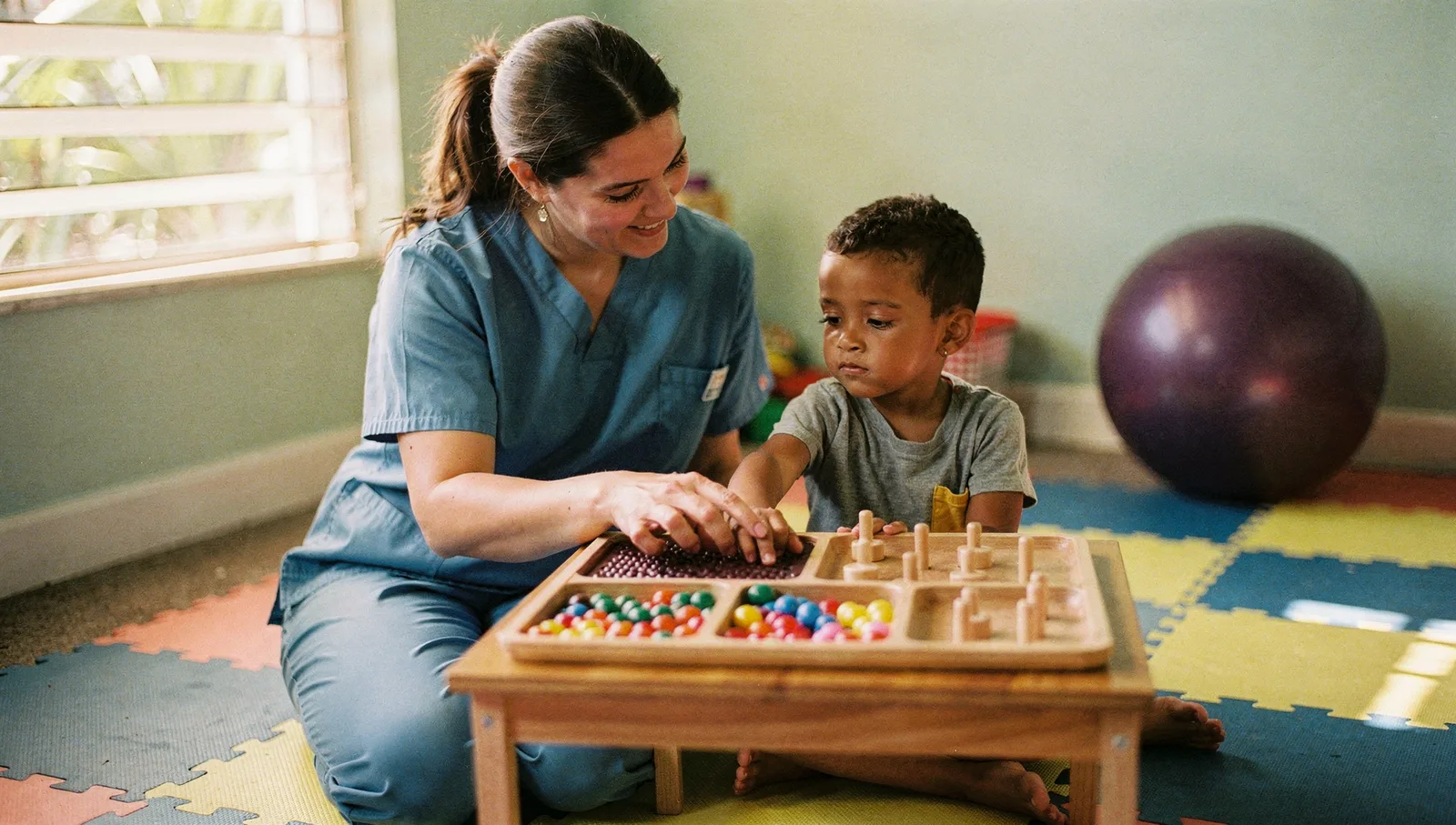
“A comprehensive review published in the Journal of Applied Behavior Analysis found that intensive ABA intervention can lead to significant improvements in communication, social skills, and adaptive behaviors in children with autism, including those who are nonverbal.”
— <UNKNOWN>
“Research indicates that children who receive 25-40 hours of ABA therapy per week for two or more years show substantial improvements in intellectual functioning, language development, and daily living skills compared to those receiving less intensive interventions.”
— <UNKNOWN>
It's 2 a.m., and you're searching for answers because your child is nonverbal, the autism diagnosis is still fresh, and you've heard ABA therapy might help, but you don't know what it actually does, whether it works, or how to afford it. You're not alone. An estimated 25-30% of children with autism spectrum disorder remain minimally verbal or nonverbal, and many families in South Florida and the Keys face months-long waitlists and long drives to find care. This guide walks you through what ABA therapy is, how it works for nonverbal children, what the research actually shows, and how to navigate access and cost in Florida, in plain language, with sourced facts, never overpromised outcomes.
ABA Therapy for Nonverbal Children: What the Evidence Actually Shows#
ABA stands for Applied Behavior Analysis. It's a discipline that uses structured teaching and data collection to help children with autism build skills, especially communication, social interaction, and daily living tasks. For nonverbal children, ABA doesn't promise speech; it builds functional communication in whatever form works for that child: spoken words, sign language, picture systems, or a combination.
The evidence is real but nuanced. Intensive ABA intervention of 25-40 hours per week for two or more years is associated with substantial improvements in intellectual functioning, language development, and daily living skills. When researchers measure expressive language skills using standardized assessments, the effect size is 1.47, a large, meaningful effect. For nonverbal IQ, the effect size is 0.65, which is moderate but clinically important. These numbers mean that children who receive intensive, well-designed ABA show measurable gains in communication and thinking skills compared to children who don't.
But The honest part: not every child responds the same way, and not every family can sustain intensive hours. Of children who start ABA services after referral, 66% actually begin therapy. Of those who begin, only 28% attend at least 80% of the recommended hours, what researchers call "full dose". And at the 24-month mark, 46% of children remain in ABA services. That means barriers are real: cost, waitlists, family capacity, and the sheer logistics of getting to appointments.
Impact on Language Development and IQ: Effect Sizes That Matter#
The largest effect ABA shows is on expressive language, the words and phrases a child produces. An effect size of 1.47 is considered large in research terms, meaning the gap between children who receive intensive ABA and those who don't is substantial. In practical terms, a nonverbal child who receives intensive ABA over an extended period with consistent delivery is far more likely to develop functional speech, sign language, or augmentative communication than a child who receives minimal or no intervention.
Nonverbal IQ, a measure of reasoning and problem-solving without language, shows an effect size of 0.65. That's moderate, not huge, but it reflects real cognitive gains. Adaptive behavior (the skills a child uses in daily life: eating, dressing, following routines, socializing) shows an effect size of 0.95, which is substantial.
The broader picture: when comprehensive ABA-based interventions are compared to treatment as usual (standard school services or minimal therapy), the effect size on intellectual functioning is 0.51. That's meaningful, it's the difference between a child making slow progress and a child making visible, measurable gains.
Long-Term Outcomes: Retention Rates and Measurable Change#
What actually happens over time. Of children who start ABA, 46% remain in services at 24 months. That's not a failure rate; it reflects the reality that some families move, some children transition to school-based services, and some reach goals and graduate. Of the studies researchers reviewed, 0%, 2% of children showed regression (loss of skills) from ABA intervention. That's reassuring: ABA doesn't make things worse.
The mixed picture: 13%, 36% of reviewed studies showed mixed findings, some skills improved, others plateaued. And 0%, 13% showed no measurable change. This variation is real. It tells you that ABA works well for many children, works partially for some, and doesn't move the needle for a few. The honest answer is that response depends on the child's starting point, the quality of the program, the intensity and consistency of delivery, and the family's ability to reinforce skills at home.
Who Benefits Most: Intensity, Duration, and Individual Response Patterns#
The research is clear on one point: intensity and duration matter. Intensive ABA intervention of 25-40 hours per week for two or more years is associated with substantial improvements. That's a lot of hours, it's roughly a full-time job for a parent or a significant commitment to clinic-based therapy. Not every family can do it, and not every child needs it. But the data shows that children who receive that level of service make bigger gains.
Younger children (typically under age 5) tend to show larger gains than older children, though ABA can help at any age. Children with some language or social skills at baseline often progress faster than those starting from zero. And children whose families are actively involved, coaching parents, reinforcing skills at home, show better outcomes than those in clinic-only programs.
The deeper pattern: ABA works best when it is intensive, consistent, individualized, and embedded in the child's daily life. A few hours a week in a clinic, without caregiver involvement, is unlikely to produce the effect sizes the research reports. That's not a criticism of ABA; it's a statement about what the evidence actually supports.
Core ABA Strategies for Nonverbal Communication Development#
Understanding Nonverbal Communication in Autism: Foundation for Strategy Selection#
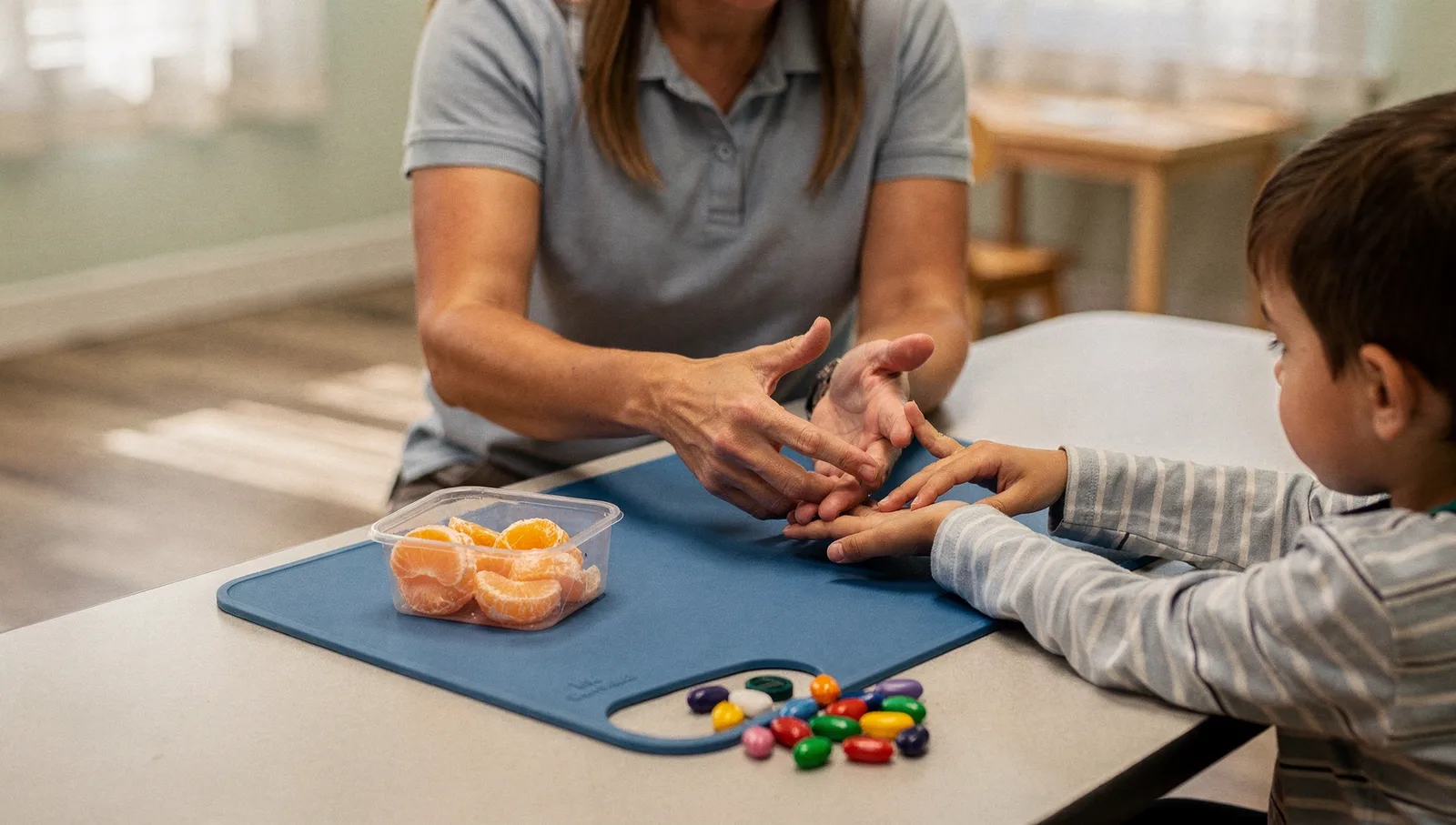
Before you can teach communication, you need to understand what nonverbal communication looks like in autism. Many nonverbal children communicate constantly, through gestures, sounds, eye contact, behavior, and body language. The problem isn't that they don't communicate; it's that their communication is hard for others to understand, or it doesn't get them what they need in the wider world.
A child might point to a door and make a sound to ask for help opening it. That's communication. But if the child can't use words, signs, or pictures to ask for the same thing in a classroom or a doctor's office, they're at a disadvantage. ABA therapy for nonverbal children focuses on building communication that works across settings and with different people, not replacing the child's natural communication, but expanding it.
Nonverbal communication in autism also includes what's called "challenging behavior", tantrums, aggression, self-injury. Often, these behaviors ARE communication. A child might scream and hit because they're overwhelmed, frustrated, or don't know how to ask for a break. ABA teaches the child a better way to communicate the same need: a sign, a word, a picture, a gesture. When the child learns that asking for a break works better than screaming, the screaming often decreases. That's not punishment; it's teaching a more effective communication strategy.
Discrete Trial Training (DTT) and Structured Teaching Techniques#
Discrete Trial Training is one of the most common ABA techniques. It's structured, one-on-one teaching broken into small, repeatable steps. How it works in practice.
A therapist sits with a child and presents a clear instruction: "Touch your nose." The child either does it or doesn't. If the child touches their nose, they get immediate reinforcement, praise, a favorite toy, a snack, whatever motivates that child. If they don't, the therapist may provide a prompt (gently guiding the child's hand) and then reinforce the correct response. Over many repetitions, the child learns the skill.
DTT is powerful because it breaks complex skills into tiny pieces, provides immediate feedback, and uses data to track progress. A therapist might run many discrete trials in a single hour, each one recorded: did the child respond correctly? Did they need a prompt? How long did it take? That data tells you exactly what's working and what needs adjustment.
For nonverbal children, DTT is used to teach:
- Receptive language (understanding words and instructions)
- Imitation (copying sounds, actions, gestures)
- Labeling (pointing to or signing a picture when asked "What is this?")
- Requesting (using a word, sign, or picture to ask for something)
- Following multi-step directions
DTT works best in a quiet, controlled setting where distractions are minimal. It's not how children naturally learn, but for children with autism who struggle to pick up skills from everyday interaction, the structure and repetition are often necessary.
Functional Communication Training: Building Real-World Language Skills#
Functional Communication Training (FCT) is ABA's answer to the question: "How do I teach communication that actually works in real life?"
Instead of drilling isolated skills in a clinic, FCT teaches the child to communicate in the contexts where they need it. A child who can label pictures in a therapy session but can't ask for a snack at home isn't making functional progress. FCT focuses on teaching communication that gets the child what they need: asking for food, a toy, help, a break, or comfort.
A concrete example. A nonverbal child with autism often screams when they're overwhelmed. A therapist might teach the child to use a picture card or a sign for "break" instead. They practice in the clinic, but they also practice at home, at school, and in the community. When the child uses the "break" sign and actually gets a break, the behavior is reinforced.
FCT often combines with Natural Environment Training, teaching skills in the places where the child actually lives and learns, not just in a clinic. A therapist might come to the child's home or school and teach communication during real routines: mealtimes, transitions, play, or social interactions.
Sensory and Regulatory Needs Alongside Communication Goals#
Many nonverbal children with autism have sensory sensitivities or difficulty regulating their emotions and arousal. A child who is overwhelmed by noise, light, or touch, or who is in a dysregulated state (too activated or too shut down), is not ready to learn communication skills. ABA therapy that ignores sensory and regulatory needs will fail.
Good ABA programs for nonverbal children include sensory breaks, movement, and calming strategies as part of the session. A therapist might notice that a child is getting frustrated and offer a break with a weighted blanket or a spinning toy. That's not a distraction from therapy; it's part of therapy. A regulated child learns; a dysregulated child doesn't.
Some ABA programs also incorporate sensory-motor activities, swinging, jumping, pushing, climbing, because these help children regulate their nervous systems. Others use visual supports (schedules, timers, picture cards) to help children understand what's happening and reduce anxiety. These aren't separate from ABA; they're integrated into it.
The Antecedent-Behavior-Consequence (ABC) model is the foundation of ABA. The antecedent is what happens before (the trigger or the instruction). The behavior is what the child does. The consequence is what happens after (the reinforcement or the response). By understanding the ABC sequence, therapists can set up the environment to make learning easier and challenging behavior less likely.
Individualized Assessment, BCBA Oversight, and Progress Monitoring#
Comprehensive Assessment and Individualized Intervention Planning#
Before ABA therapy starts, a comprehensive assessment should happen. This isn't a single test; it's a detailed evaluation of the child's current skills, challenges, and learning style. A Board Certified Behavior Analyst (BCBA) typically leads this assessment, looking at:
- Communication skills (what the child understands and produces)
- Social skills (how the child interacts with others)
- Play and leisure skills
- Daily living skills (eating, toileting, dressing)
- Academic readiness
- Challenging behaviors (what triggers them, what maintains them)
- Sensory sensitivities
- Family priorities and resources
The assessment informs an Individualized Intervention Plan, a detailed roadmap of what skills to teach, in what order, using which strategies. This plan is not generic; it's built for that specific child, in that specific family, with that specific set of goals.
For a nonverbal child, the plan might prioritize functional communication first: teaching the child to request preferred items, ask for help, and indicate "no" or "all done." Once those foundations are in place, the plan might expand to social skills, play skills, or academic readiness. The order matters because it builds on what the child can already do.
Role of Board Certified Behavior Analysts (BCBAs) and Registered Behavior Technicians (RBTs)#
A BCBA is a licensed professional who has passed a national certification exam and meets ongoing education requirements. In Florida, BCBAs must also be licensed as mental health counselors or have equivalent credentials. A BCBA designs the intervention plan, oversees the therapy, analyzes data, and adjusts the program based on progress.
Registered Behavior Technicians (RBTs) are the therapists who deliver the day-to-day sessions. An RBT has passed a certification exam and works under BCBA supervision. In a well-run program, an RBT might see a child regularly throughout the week, and a BCBA reviews the data and adjusts the plan frequently.
The distinction matters because oversight is where quality happens. A BCBA who is actively reviewing data, meeting with the family, and adjusting the program based on progress is the difference between therapy that works and therapy that just happens. A BCBA who is supervising 50+ cases and never sees the child is a red flag.
In Florida, Permuy Diversity Intervention operates with licensed BCBAs and RBTs across the Florida Keys and Miami-Dade County, including Homestead, Kendall, Hialeah, Marathon, and Key West. The team is trained to work with nonverbal children and bilingual families, and they prioritize active caregiver coaching and data-driven adjustments.
Data Collection and Progress Monitoring Tools: Measuring What Matters#
ABA is obsessed with data because data tells you whether the intervention is working. Over weeks and months, that data is graphed and analyzed to see if the child is making progress.
Common progress monitoring tools include:
- Frequency counts: How many times did the child use a target skill? (e.g., "requested 12 times today")
- Duration: How long did the child engage in a skill? (e.g., "attended to task for 8 minutes")
- Latency: How quickly did the child respond? (e.g., "responded within 3 seconds")
- Percentage correct: Out of 10 trials. How many did the child get right?
- Generalization probes: Does the child use the skill in settings other than therapy?
A BCBA reviews these data regularly and asks: Is the child making progress? If yes, is the progress fast enough, or do we need to adjust the strategy? If no, what's getting in the way? Is the child not understanding the skill, not motivated by the reinforcer, or dysregulated?
Measuring progress through frequent data collection, graphing, and analysis is what separates ABA from other therapies. You're not guessing whether therapy is working; you're measuring it. And when measurement shows that something isn't working, you change it.
Beyond Clinical Sessions: How ABA Works as a Family System#
Caregiver Coaching and Parent Training as Core Intervention#
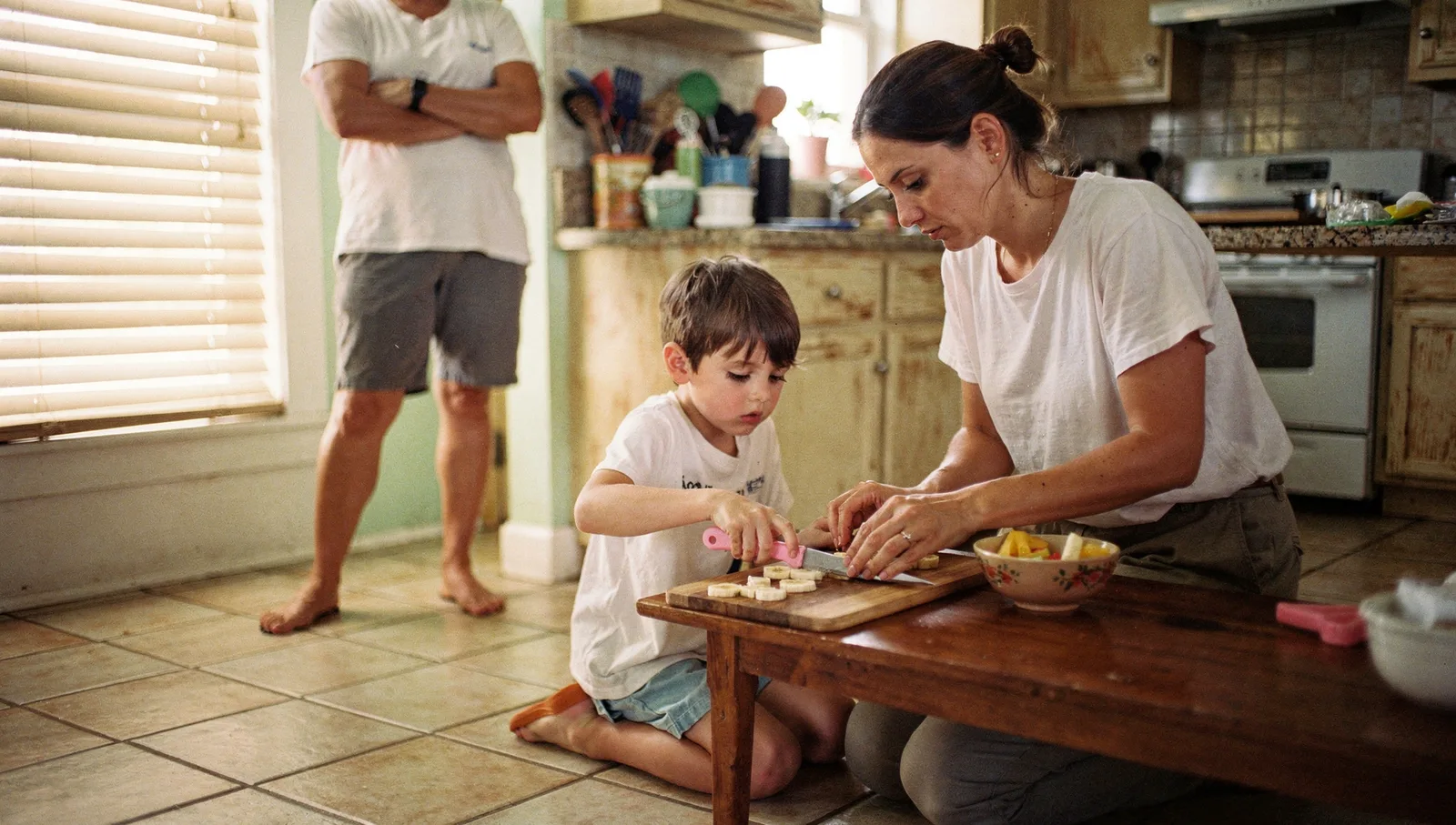
The uncomfortable truth: a child who receives intensive ABA in a clinic but goes home to a parent who doesn't understand or reinforce the skills will make slow progress. The most effective ABA programs treat the parent or caregiver as a co-therapist, not a bystander.
Caregiver coaching means a therapist or BCBA works with you, the parent, to understand the child's skills, the teaching strategies, and how to reinforce learning in daily life. Instead of just dropping off your child at therapy, you're learning how to teach during meals, transitions, play, and routines at home.
A coach might show you how to use the Antecedent-Behavior-Consequence model during breakfast. The antecedent is you placing a bowl and spoon on the table. The behavior is your child reaching for the cereal. The consequence is you handing them the cereal and praising them. Over time, your child learns that reaching (or signing, or saying "cereal") gets them what they want. That's therapy happening at home, without a therapist present.
Parent training is especially critical for nonverbal children because communication skills need to be practiced across many people and settings. A child who can request a snack from a therapist but not from a parent or teacher hasn't really learned the skill. Coaching ensures that everyone in the child's life is using the same strategies and reinforcing the same skills.
Extending ABA Into Daily Life: Generalization and Real-World Application#
Generalization is the goal: the child uses a skill in new settings, with new people, and in new contexts. A child who can label pictures in a therapy session but can't identify objects in a grocery store hasn't generalized the skill.
Good ABA programs build generalization into the plan from the start. A therapist might teach a child to request a toy in the clinic, then practice requesting in the home, then in a park, then with a sibling. Each setting is slightly different, so the child learns that the skill works everywhere.
Natural Environment Training (NET) is one way to build generalization. Instead of a therapist coming to a clinic, they come to the child's home or school and teach during real routines. A child learns to request a snack during actual snack time, not during a drill. A child learns to follow directions during a real transition, not during a practice trial. This approach is slower in some ways, you're not running as many structured repetitions per hour, but it's faster at building skills that actually work in the child's life.
Transition Planning: Moving From Early Intervention to School-Based Services#
Many nonverbal children start ABA through early intervention programs (birth to age 3) or private therapy. When the child enters school, tOften a transition to school-based services. This transition is critical and often mishandled.
A good transition plan includes:
- A meeting between the early intervention team (or private ABA provider), the school, and the family to share data and goals
- An Individualized Education Program (IEP) that reflects the child's communication and learning needs
- Coordination between school staff and any private ABA services the family continues
- Training for school staff on the strategies that have been working
- A timeline for the transition that gives the child time to adjust
The risk is that a child makes progress in early intervention or private ABA, then transitions to school where the strategies are different or less intensive, and progress stalls. Permuy Diversity Intervention works with families and schools to ensure continuity: the strategies that worked in therapy are reinforced in the classroom, and the school's IEP goals align with the child's communication priorities.
Closing the gap between what a child can do in a structured therapy setting and what they can do in the real world, home, school, community, is why ABA therapy and autism services discipline exists. That's where the transition plan matters most.
Accessing ABA Services in Florida: Finding Providers and Managing Costs#
Finding ABA Services Without Waitlists: South Florida and Keys Coverage#
If you're in South Florida or the Florida Keys, you know the challenge: waitlists for autism services can stretch for extended periods. Many families are told to wait many months for an evaluation, let alone therapy. That delay costs the child critical early intervention years.
Permuy Diversity Intervention serves the Florida Keys and Miami-Dade County without the typical waitlists. Licensed BCBAs and RBTs are available in Key West, Marathon, Hialeah, Kendall, Homestead, and throughout Miami-Dade County. The team is trained to work with nonverbal children and bilingual families, and they prioritize getting children started quickly.
The advantage of a smaller, local provider is responsiveness. You're not a case number in a large system; you're a family the team knows. If your child's needs change, the program adjusts. If you have questions, you can reach a BCBA directly, not a voicemail system.
Understanding ABA Therapy Costs and Insurance Navigation#
ABA therapy is expensive. Intensive services cost a wide range depending on the provider, location, and whether sessions are in a clinic or in the home. In Florida, costs vary considerably based on these factors.
Most families rely on insurance to cover ABA. Florida Medicaid covers ABA therapy for children with autism, and many private insurance plans do as well. The coverage varies: some plans cover high-frequency services, others cap at lower levels. Some require prior authorization, others don't. Some have copays, others don't.
Navigating insurance is its own skill. You need to know:
- Does your plan cover ABA? (Call your insurance company or check your policy.)
- How many hours per week are covered?
- Do you need prior authorization?
- What's your copay or coinsurance?
- Does the provider accept your insurance, or will you pay out-of-pocket and seek reimbursement?
Permuy Diversity Intervention accepts Medicaid and works with many private insurance plans. The team can help you navigate coverage, submit prior authorization requests, and understand your benefits. This is not a small thing: many families spend hours on the phone with insurance companies, and having a provider who handles this is invaluable.
Cost-Benefit Analysis: What Intensive ABA Delivers vs. Out-of-Pocket Investment#
The honest calculation. The effect sizes on expressive language (1.47) and adaptive behavior (0.95) are large.
What does that mean in real terms? A nonverbal child who receives intensive ABA over an extended period with consistent delivery is far more likely to develop functional communication, attend mainstream or inclusive school settings, and require less support as an adult. The long-term cost savings, in special education services, adult day programs, and residential care, are substantial.
But the upfront cost is real. If your insurance covers ABA, your out-of-pocket cost might be minimal. If you're paying privately, or if your insurance has limits, you might be paying a few thousand dollars a month. That's a significant financial commitment for many families.
The cost-benefit question is personal. Some families prioritize intensive ABA because they believe the long-term gains justify the cost. Others can't afford it and seek lower-intensity services or school-based therapy. Neither choice is wrong; both reflect real constraints.
What matters is that you understand what the research shows: intensive, well-designed ABA works. If you can access it, the evidence supports the investment. If you can't, partial services are better than nothing, and school-based services combined with parent coaching can also produce gains.
Measuring Progress and Taking the Next Step#
You now understand what ABA is, how it works for nonverbal children, what the research shows, and how to access it in Florida. The last step is to assess your own situation and decide what to do next.
A checklist to guide you:
- Does your child need an ABA assessment? If your child is nonverbal or minimally verbal and you haven't had a comprehensive ABA evaluation, that's the first step. A BCBA can tell you whether ABA is appropriate and what intensity might help.
- What's your insurance situation? Call your insurance company or check your policy. Does it cover ABA? How many hours? Do you need prior authorization? Write down the answers; you'll need them.
- What are your family's priorities? Do you want intensive clinic-based therapy, in-home coaching, school coordination, or a mix? What hours work for your schedule? What's your budget?
- Who will deliver the therapy? Is the provider licensed (BCBA and RBT credentials)? Do they have experience with nonverbal children? Will they involve you as a co-therapist? Do they accept your insurance?
- How will progress be measured? Ask the provider how they track progress, how often they adjust the plan, and how they involve you in data review. If they can't answer these questions clearly, that's a red flag.
The honest truth is that finding good ABA therapy is hard. Waitlists are long, costs are high, and quality varies. But the research is clear: intensive, well-designed ABA works for many nonverbal children. If you can access it, the evidence supports trying.
If you're in South Florida or the Florida Keys and you're ready to explore ABA for your nonverbal child, a bilingual ABA team who gets it, Medicaid-approved therapy and counseling in English or Spanish, is the next step. Talk to a team that prioritizes data-driven progress, caregiver coaching, and real-world communication skills. That's where the work actually happens.
Dr. Luis D. Permuy, LMHC-QS, Founder & Licensed Mental Health Counselor, has worked with nonverbal children and their families across South Florida for years. He knows the waitlists, the financial strain, and the late-night searches for answers. This article reflects his commitment to sourced, honest information, never overpromised outcomes, delivered in the language and tone that actually reaches families when they need it most.
| Outcome Measure | Effect Size | Research Interpretation |
|---|---|---|
| Expressive Language Skills | 1.47 | Large, meaningful effect |
| Nonverbal IQ | 0.65 | Moderate but clinically important |
| Adaptive Behavior Socialization | 0.95 | Substantial effect |
| General IQ (Long-term Comprehensive ABA) | 1.19 | Large effect |
| Intellectual Functioning (vs. Treatment as Usual) | 0.51 | Meaningful improvement |
| Enrollment Stage | Percentage of Children |
|---|---|
| Start ABA services after referral | 66% |
| Attend at least 80% of recommended hours (full dose) | 28% |
| Remain in ABA services at 24 months | 46% |
| Outcome Category | Percentage of Reviewed Studies |
|---|---|
| Regression (loss of skills) | 0%–2% |
| Mixed findings (some improvement, some plateau) | 13%–36% |
| No measurable change | 0%–13% |
ABA Therapy Out-of-Pocket Cost Estimator
Estimates expected annual and monthly out-of-pocket costs for ABA therapy based on prescribed weekly hours, insurance structure (copays, coinsurance, remaining deductible, and out-of-pocket maximum).
Total Annual Billed Therapy Value:
Estimated Annual Out-of-Pocket Cost:
Estimated Monthly Out-of-Pocket Cost:
Frequently Asked Questions
How long does it take to see results from ABA therapy for a nonverbal child?
Intensive ABA sustained over an extended period, typically two or more years at 25-40 hours per week, produces substantial measurable gains in language, thinking skills, and daily living ability. Individual timelines vary: younger children and those with some baseline communication often progress faster. Consistent, high-dose delivery yields the largest effect sizes; part-time or inconsistent services produce smaller gains.
Will ABA therapy make my child regress or lose skills?
Regression from ABA intervention is extremely rare. Research shows 0%, 2% of reviewed study records reported skill loss from ABA treatment. The concern about harm from structured behavior intervention is not supported by evidence. Most children either improve, show mixed progress on specific skills, or maintain baseline function.
What prevalence of autism spectrum disorder remains nonverbal or minimally verbal?
An estimated 25-30% of children with autism spectrum disorder remain minimally verbal or nonverbal. Additionally, approximately 40% of children diagnosed with autism spectrum disorder have significant language delays. These figures underscore why communication-focused interventions like ABA matter for a substantial portion of the autism population.
Does ABA work better for younger children with autism than older children?
Younger children, typically under age 5, tend to show larger gains from ABA than older children, though ABA can help at any age. Children with some language or social skills at baseline also progress faster than those starting from zero. Starting earlier and combining clinic-based services with active caregiver coaching at home yields better outcomes.
What percentage of families can maintain the recommended intensity of ABA therapy?
Only 28% of children attend at least 80% of the recommended ABA hours (full dose), reflecting real barriers families face: cost, long waitlists, travel logistics, and the demands of intensive therapy on family life. At 24 months, 46% of children remain enrolled; attrition reflects transitions to school services, family relocation, and goal completion, not failure.
Why do some children show no change from ABA therapy?
Research shows 0%, 13% of reviewed studies reported no measurable change from ABA intervention. Outcomes depend on starting point, program quality, intensity and consistency of delivery, and family reinforcement at home. ABA works best when delivered intensively (25-40 hours per week), consistently over years, and embedded in daily life with caregiver involvement, not part-time clinic-only services.
Disclaimer
The information provided by Permuy Diversity Intervention is for general educational purposes only and is not a substitute for professional medical advice, diagnosis, or treatment. ABA therapy and mental-health services are individualized; always consult Dr. Luis D. Permuy, LMHC-QS, or a qualified clinician about your child's specific needs. Insurance coverage, eligibility, and Florida Medicaid rules change - verify current details with your plan and the Florida Agency for Health Care Administration.
Sources
- pmc.ncbi.nlm.nih.gov (via Perplexity Sonar) - PMC (2026-08-29)
- pmc.ncbi.nlm.nih.gov (via Perplexity Sonar) - PMC (2026-08-29)
- pubmed.ncbi.nlm.nih.gov (via Perplexity Sonar) - Pubmed (2026-08-29)
- ncbi.nlm.nih.gov (via Perplexity Sonar) - Ncbi (2026-08-29)
- Federal Autism Activities: Agencies Are Encouraging Early ... - GAO (2026-08-29)
- ABA for Nonverbal Children: Strategies and Tools | Links - Linksaba (2025-06-19)